.png)
When someone hands in their notice, the work starts right away. A reliable employee offboarding checklist keeps that work on track. You can properly close their employment, protect company data, and pay them what they’re owed, all while keeping the team running.
Miss a step, and the costs are real. You might send a late final payment, leave an account open for months, or lose knowledge when no handover happens.
An employee offboarding checklist keeps all of that in one place, so nothing depends on someone remembering it under pressure. This guide covers what to put on the checklist and who owns each part. It also shows how the process shifts depending on why the person is leaving.
It’s written for HR and people-ops teams who want a process they can reuse for every departure. That includes a resignation, a retirement, or a role that’s being cut.
One idea sits underneath the whole thing: offboarding is a cross-functional business process that several teams run together.
Key takeaways
-
An employee offboarding checklist provides a repeatable set of steps for every departure, so critical tasks like revoking access or paying out leave don’t get missed.
-
Offboarding is cross-functional. People ops, IT, payroll, finance, and managers each own part of it, with one person coordinating end-to-end.
-
Accurate employee data is the foundation. When records are wrong or scattered, the errors show up in final pay, benefits, and compliance.
-
The core workflow stays the same, but it branches by departure type. Dismissals need legal care, and retirements add documentation.
-
Fix the process and data ownership first, then use a workflow tool to make the checklist repeatable.
What is employee offboarding?
The aim is to wind the role down in an orderly way. Both sides get a clean break, with no open accounts, unpaid balances, or lost knowledge left behind.
A good process is predictable. As Joanna Augustyn, People Operations Specialist at Tellent, puts it:
That last point is worth holding onto. Offboarding is done when the employee has received everything they’re entitled to, and the company has recovered what belongs to it. By then, access and systems are handled, payroll is closed, and the documentation is complete.
Why a structured offboarding checklist matters
People leave jobs all the time, so offboarding isn’t a rare event you can improvise. Across the EU, a steady share of employees change jobs or leave employment every year, as Eurostat labour market flow statistics show. Every one of those exits has to be handled somewhere.
When each departure runs differently, steps get missed. An access account stays live, a final payment is wrong, or a client relationship goes cold because no one picked it up. A checklist replaces that ad hoc handling with the same sequence every time, and you can also show it to an auditor later.
It also protects the people involved. The departing employee gets a fair exit, and the team keeps working without a gap. For a small HR team, running each departure the same way keeps the workload steady instead of turning every exit into a scramble.
The complete employee offboarding checklist, step by step
Here’s the core checklist. The steps run in roughly this order, though several overlap once a leaving date is set. Each one has a main owner, which we cover in more detail further down.
|
Step |
Main owner |
|---|---|
|
Confirm the facts of the departure |
People ops |
|
Calculate the leave balance and final pay |
Payroll, with people ops |
|
Recover equipment and revoke access |
IT |
|
Hand over knowledge |
Manager |
|
Complete documentation and data retention |
People ops |
|
Run the exit interview |
HR or people ops |
1. Confirm the facts of the departure
Start by establishing exactly what kind of departure this is. Note the employment type, the notice period, and the last working day.
Record whether the person works the notice or goes on garden leave, plus the reason for leaving. This first step shapes every step after it.
The reason and departure type decide which conditional steps apply later, so it’s worth getting them right on day one.
2. Calculate the leave balance and final pay
Next, work out how much leave the employee has left. Depending on local law and their contract, unused days are either taken before the end date or paid out in the final payroll run.
Treat leave, final pay, settlement, and benefits as one chain. A change to the leave balance affects the final payment, which affects everything after it.
That's why accurate leave records matter. Marieke Drees, VP of People at Tellent, explains what happens without them:
Up-to-date records mean fewer manual corrections in the final payroll run, and fewer awkward follow-ups with someone who's already left.
3. Recover equipment and revoke access
Collect company property and close down access on the employee's last working day. That covers physical items like their laptop, phone, access cards, and keys, plus every account and tool they can still log into.
For remote employees, send a prepaid return shipping label. Ask them to pack equipment in its original box and protective materials, if they still have them, so it arrives back undamaged.
For most leavers, access removal can run from a standard checklist. Role-based access makes it faster: if permissions are tied to a role, you can see exactly what to remove rather than guessing what they had access to.
Be clear about who owns this step. In many companies, Security or IT removes access and collects password information, including for any shared accounts or team logins the person used. Change those passwords once the employee has left.
Decide who takes over the person's inbox and files. Often that's their manager, but it depends on company policy and can vary case by case. Set it up before access is removed, so nothing gets lost.
If you operate in the EU, keep GDPR in mind. A former employee's mailbox may contain personal emails, so limit access to what's needed for the handover.
Sensitive exits, such as a dismissal or someone moving to a competitor, may need a different process. For example, some companies revoke access before the last working day. Agree the approach with HR, IT, and legal ahead of time.
4. Hand over knowledge and let the manager own the experience
Knowledge transfer is often skipped, and that creates avoidable costs. Document key processes, share contacts and project status, and make sure someone can pick up the work. The manager owns this part, along with communicating the departure to the team.
Give the manager specific tasks and a deadline, so the handover happens while the person is still around to explain their work.
5. Complete documentation, data retention, and compliance
Finish the paperwork, confirm which records you’re legally required to keep, and delete what you no longer have a reason to hold. The principle is simple: keep personal data only as long as its purpose requires. A human resources information system (HRIS) can even do this for you:
This is a compliance point in addition to good housekeeping. Under GDPR Article 83, violating core data principles can incur fines of up to €20 million or 4% of annual worldwide turnover. That’s a ceiling rather than a typical penalty, but it’s reason enough to put retention rules on the checklist.
6. Run the exit interview
In the person's final week, send an exit survey and hold an exit interview. Have someone other than their direct manager run it, like an HRBP, and make clear there are no negative consequences for what they share. People are more open when they know that.
Ask the same core questions each time: why they're leaving, what could have changed their mind, and how they found their manager and team. Group reasons into set categories like pay, growth, or workload.
One interview tells you little on its own. The value comes from patterns across exits, like repeated mentions of one team or a missing career path. Share those themes with leadership, keep individual answers confidential, and use them to improve things for the people who stay.
Who owns each part of the offboarding process?
Offboarding needs a single owner who coordinates the whole thing, usually the people-operations lead. That person coordinates timing throughout the process and ensures each step happens on time.
From there, the work splits across teams. Keeping ownership explicit helps prevent delays when work moves between teams. Most offboarding breakdowns happen at these handoffs, when no one triggers the next action.
|
Team |
What they own |
|---|---|
|
People ops |
The process, and making sure everything happens at the right time |
|
IT |
Equipment and access to tools |
|
Payroll |
Payroll processing |
|
Finance |
Other financially relevant steps |
|
Manager |
The team experience |
This is why treating offboarding as an HR-only job tends to fail:
All of this rests on trustworthy data. If a record is wrong at the start, the mistake affects payroll, benefits, IT access, and exit reporting.
Give each piece of employee information one source of truth, so the whole team works from the same numbers. Document the steps clearly enough that a holiday or absence never halts the process, and designate a backup for each task.
How offboarding changes by departure type
The core workflow is standard, but it branches based on why the person is leaving.
-
Resignation is usually the most predictable case, since the employee starts the exit and works a set notice period.
-
Dismissal or reduction in force needs tighter coordination with legal and HR, because timing and documentation are sensitive.
-
Retirement adds documentation, extra payroll and benefits steps, and, in some countries, a statutory retirement payment that payroll has to calculate.
Local rules matter here too. Even when someone asks to have their data deleted, you may still need to retain certain HR records for a set period. EU guidance sets out when.
Build these branches into the checklist as conditional steps, so the right version runs once you’ve confirmed the reason in step one.
Common offboarding mistakes to avoid
Most offboarding problems come from a handful of predictable errors. Watch for these:
-
Ignoring the resignation until the last few days. Carrying on as normal leaves you rushing the handover with no time to spare.
-
Leaving the whole transition to the departing employee. They’re already preparing to leave, so ownership has to sit with the manager and people ops.
-
Running offboarding differently for different roles. Uneven treatment means senior exits get attention while others lose knowledge quietly.
-
Working from scattered records. When data lives in spreadsheets, email, and drives with no agreed version, final-settlement math slows down and errors creep in.
Turn your checklist into a repeatable workflow
Before you add a new tool, settle who owns the data and which system is your source of truth. A tool runs your existing process faster, whether that process is good or bad. As Joanna Augustyn puts it:
Once the process is sound, a workflow tool makes it repeatable. Tellent HR is built and hosted in Europe on ISO-certified, GDPR-compliant infrastructure, which matters when you're handling employee data at the end of their employment.
The Journeys feature turns your offboarding checklist into a structured workflow. You get reusable templates, clear task owners, and automated steps, such as data deletion.
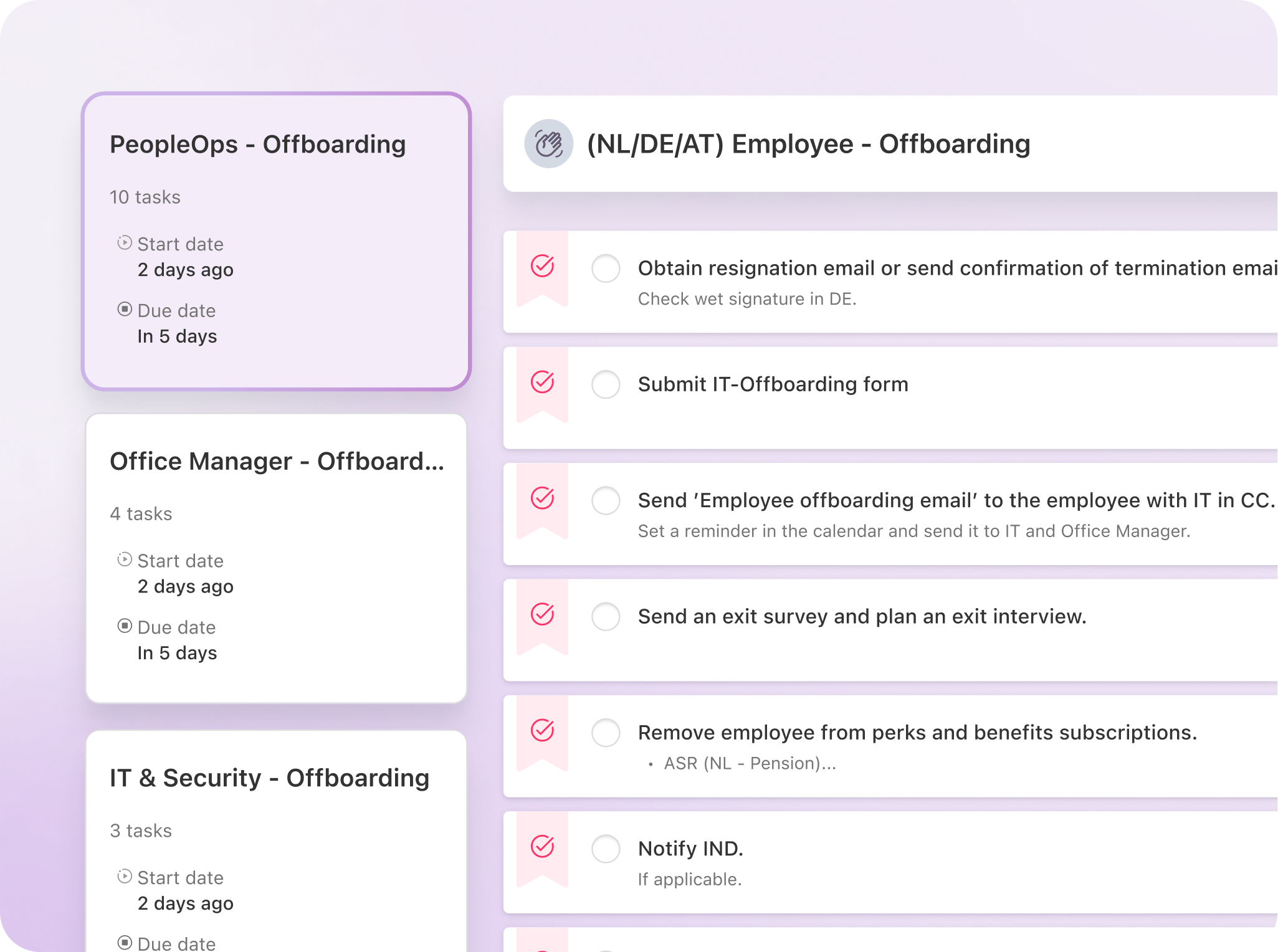 Separate task lists for People Ops, the office manager, and IT & Security in Tellent HR, each with its own due date, so everyone knows their part in the offboarding process.
Put your offboarding checklist into practice
Turn this guide into something your team can act on. Start by writing down your current offboarding steps and marking who owns each one, then compare them against the checklist above to identify any gaps.
Pick one recent departure and walk it through the steps end to end. You’ll quickly see where a task had no owner, where a record was out of date, or where access stayed open too long. Fix those handoffs first, since that’s where most offboarding breaks down.
Once the process is documented on paper, decide which system serves as the source of truth for employee data. Then work out where a workflow tool could take over the manual reminders.
Bringing your offboarding process together
Good offboarding comes down to coordination. When one person owns the timeline, the data is accurate, and each team knows its part, the checklist mostly runs itself.
The payoff builds over time. Every exit handled the same way leaves cleaner records, fewer payroll corrections, and a former colleague who speaks well of you.


.jpg?width=1000&name=%5BEN%5D%20Employee%20onboarding%20process%20-%20Website%20image%20-%201220x740%20(1).jpg)