.png)

A 360-degree feedback process gathers input on one person from the people who work with them. That usually means their manager, their peers, and their direct reports. The employee also adds their own self-assessment.
Together, these views build a fuller picture of how someone works day to day. It shows far more than one manager sees alone.
You’re probably reading this because you’re considering 360-degree feedback, or you’ve tried it and it didn’t land the way you hoped.
Done well, 360 feedback earns its value when you design it for development and act on what it tells you. It works less well when you treat it as a one-off scoring exercise.
Key takeaways
-
Set the purpose of the process before you pick anyone to give feedback. Every later choice follows from it.
-
Keep 360 feedback for development, and separate it from pay and promotion, so people give honest input.
-
Let employees nominate their own raters, then have the manager confirm the list and add any additional names to keep the group balanced.
-
Decide up front whether responses are named or anonymous, and tell everyone which one applies.
-
Behavior-based questions give people something to act on; a single overall score doesn’t.
-
The report is only the halfway point. Value comes when recurring themes lead to a real conversation and follow-up.
What is 360-degree feedback?
A typical group includes the person’s manager, a few peers, and their direct reports, and sometimes clients or wider stakeholders. The employee usually completes a self-assessment too, so they can compare how they see themselves with how others experience their work.
A traditional review shows one manager’s view. That manager sees only part of what someone does, and often misses the day-to-day collaboration that peers and reports see. Pulling those views together gives you a fuller, more balanced read on strengths and blind spots.
How the 360-degree feedback process works, step by step
The 360 feedback process steps are easier to run when you treat them as a repeatable sequence you can reuse each cycle. At a high level, you define the purpose, choose raters, decide on anonymity, and design the questions. Then you run the survey, share the results, and turn the feedback into action.
A tool helps here, but the order matters more than the software. If you already run performance cycles, you can slot these steps into your existing review workflows so the process remains consistent every time.
Step 1: Define the purpose before anything else
Start by naming what the feedback is for. Most often, the goal is development: helping someone build skills, or supporting a manager who's new to the role.
That purpose shapes every later choice, from who you ask to what you ask them.
The biggest call is to keep development feedback separate from pay and promotion decisions. Raters give more honest input when they know their comments won't affect a colleague's salary or next step.
It also helps to set realistic expectations. A 2005 meta-analysis in Personnel Psychology reviewed 24 longitudinal studies and found that performance improvement after multisource feedback is generally small.
Gains were more likely when recipients saw a need to change, believed they could improve, and acted on the feedback. That's why the follow-through in Step 6 matters as much as the survey itself.
Step 2: Choose raters and get manager sign-off
Good input comes from people who actually work with the employee. Aim for a mix of peers, direct reports, and the line manager, plus wider leadership where it’s relevant.
There are two common ways to build that list. The first is to let the employee nominate raters, then have the manager confirm and add names.
Nishma Kamdar, Global HR Business Partner (HRBP) at Tellent, describes how that works in practice:
That manager step keeps the group honest. Left entirely to the employee, the list can get too narrow or too friendly, so the manager fills the gaps:
The second approach skips nominations. Everyone who works closely with the person gives feedback, including all their direct reports and peers who report to the same manager. This avoids a hand-picked list, though it means more survey requests for bigger teams.
Whichever approach you choose, the setup looks similar in most tools. Settle the rater list, get manager sign-off, then send the requests.
Step 3: Decide how anonymous the process will be
Anonymity is a design choice, and the right call depends on your context. As Nishma Kamdar puts it:
Anonymous responses suit teams that are still building a feedback habit. People speak more freely when their names aren't attached.
There's research to back this up. In a 1994 Personnel Psychology study, David Antonioni looked at upward feedback at a US insurance company. Employees who had to put their name to their feedback rated their managers more leniently than those who answered anonymously.
Open responses work when trust is high, and you want direct accountability.
Whichever you choose, be explicit about confidentiality. You can track who has responded so you can follow up, without attributing individual comments in the final report. For EU teams, this also supports the GDPR's data minimization principle: you surface only the personal data the process needs.
Step 4: Design questions that produce useful feedback
A single overall score rarely tells you what to do next. Build the survey around specific, behavior-based questions. Adjust the set over time as you learn where you already have enough data and where you need more.
Manager effectiveness is worth asking about directly, and so are early signals like workload and wellbeing before they turn into disengagement.
Good 360 feedback questions surface patterns you can act on. If you already run employee engagement surveys, you can line up the themes so the two sources tell a consistent story.
Step 5: Run the survey and share results
Before you launch, tell raters what the process is for and what you expect from them, and give people enough time to respond thoughtfully. Once responses are in, compile them into a summary the employee can actually read. Then hold a conversation to talk through the themes, ideally as part of your regular performance reviews.
Treat it as a habit. Running the process roughly once a year, plus around manager transitions, lets you see whether earlier feedback led to real change.
For a first rollout, pilot with one team. Agree what success looks like, and check adoption before you widen it.
Step 6: Turn feedback into action
Feedback is only useful when it changes something. Don't over-weight one sharp comment. Look for themes that repeat across raters and across cycles, then decide what to do about them.
Joanna Augustyn, People Operations Specialist at Tellent, explains how recurring signals get picked up:
From there, turn themes into concrete next steps, like coaching, manager support, or structured development plans.
Share aggregated patterns with leadership too. Recurring themes can point to broader priorities, such as manager training or clearer career paths.
What good 360-degree feedback looks like
The quality of the questions and the quality of the answers are closely linked. Vague feedback leaves the recipient guessing. Specific, behavior-based feedback tells them exactly what to keep doing or change, usually by naming the behavior and its effect.
|
Vague feedback |
Specific, useful feedback |
|---|---|
|
“Good team player.” |
“Steps in to unblock teammates during busy sprints, which keeps releases on schedule.” |
|
“Communication could be better.” |
“In cross-team updates, decisions sometimes aren’t written down, so people miss the outcome.” |
|
“Strong leader.” |
“Runs focused one-on-ones and follows up on commitments, so reports know where they stand.” |
You don’t need every answer to read like the right-hand column. A few concrete examples per person are enough to make the report worth discussing.
Common pitfalls and why 360-degree feedback initiatives fail
When 360-degree feedback disappoints, the cause is usually the rollout, not the idea. The most common failure modes map back to the steps above:
- No clear purpose. Without one, raters don't know what kind of input is useful (Step 1).
- The wrong raters. People who don't see the person's work can't give useful feedback (Step 2).
- No agreed rule on anonymity. If raters aren't sure who'll see their comments, they hold back (Step 3).
- No plan for what happens next. The report lands, and nothing changes (Step 6).
Misuse is its own risk. If feedback gets used to catch people out, the process quickly loses trust, and honest input dries up.
Mixed ratings can also confuse recipients, so set expectations before the report arrives. A 1997 meta-analysis by Conway and Huffcutt in Human Performance found that supervisors, peers, direct reports, and the person themselves often rate the same person quite differently.
Part of that is because each group sees different parts of someone's work. Read that way, the spread is useful. It shows how someone comes across depending on the relationship.
How to choose a 360-degree feedback tool
If you’re weighing up software to run all this, compare your shortlist the same way every time. Give each must-have and nice-to-have a weight, rate every option one to five, and compare the totals. Scoring against set criteria keeps the decision consistent, rather than down to gut feel.
Use these questions as the criteria to score:
-
Can employees nominate raters and managers approve or add them?
-
Can you choose anonymous or open responses per review?
-
Where is employee data hosted, and does it meet your compliance needs?
-
Does the feedback stage connect to your wider review and development process?
Treat the first two as must-haves; the rest depend on your size and setup.
Weigh the total cost, not just the software pricing. Factor in the admin time to run each cycle, the setup and configuration effort, and training for managers and raters. That matters most for a first pilot, when the team is still learning the process.
How Tellent supports a 360-degree feedback process
Tellent HR Grow, the performance and development module in Tellent, runs 360 and peer feedback inside your performance reviews.
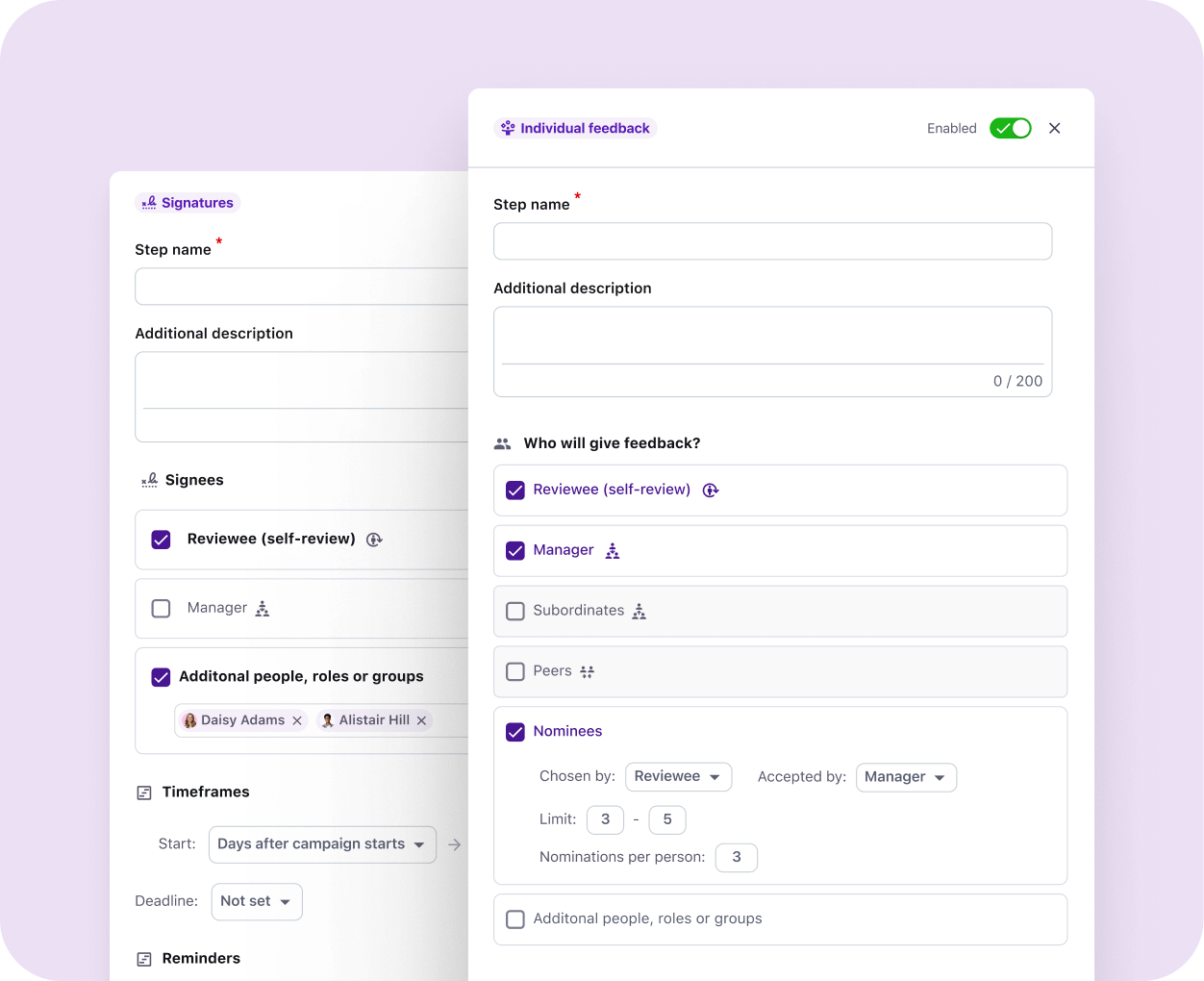
You can launch a feedback round, let employees nominate raters with manager approval, and choose whether responses are anonymous or open. Nishma Kamdar describes how the team uses it:
A common use case is supporting new managers. Their own manager rarely sees the full picture of how they lead day to day:
Tellent is built and headquartered in Europe, and its core infrastructure is hosted in Germany. International data transfers follow documented safeguards, which matters for teams handling employee data under GDPR.
Next steps for your first 360-degree feedback cycle
Starting a 360-degree feedback process doesn’t mean rebuilding how you run reviews. After your first round, compare the themes against what you expected and adjust the questions before the next cycle. A repeatable workflow keeps the admin light, so you can focus on the conversations that follow.
You can see how reviews and 360-degree feedback fit in one place with Tellent’s performance management software.