.png)
Salary has always been a sensitive subject at work. Many employees have never felt comfortable asking where they stand relative to their colleagues, and for most companies, that dynamic suited everyone just fine. The EU Pay Transparency Directive is changing that, and not gradually.
As of June 2026, employees across the European Union have had the right to request salary bracket data and median pay figures for their role. For HR teams, that means one thing: the conversation is no longer optional. The only question is whether you're ready to have it.
At Tellent, we've been navigating this firsthand. Our VP of People, Marieke Drees, has been leading our preparation — working through benchmarking tools, pay gap remediation, internal communication, and the added complexity of operating across multiple European entities. This is what we've learned, and where most HR teams still need to focus.
Key takeaways
-
The EU Pay Transparency Directive gives employees the right to request salary bracket and median pay information for their role, effective June 2026.
-
Pay equity and pay equality are two different things. HR teams need to address both, and conflating them is one of the most common mistakes companies make during preparation.
- Salary ranges must be disclosed either in the job description or at the first point of contact with candidates. Asking candidates about their salary history is also prohibited under the directive.
- The burden of proof has shifted: employers must demonstrate that pay gaps are justified — employees no longer have to prove discrimination.
- If a gender pay gap exceeds 5 percent and cannot be justified within six months, the directive requires a formal joint assessment with employee representatives.
- Companies are also required to report pay gap data to government authorities, though reporting deadlines vary by country.
- Preparation takes longer than most companies expect — especially if your HRIS doesn't integrate with benchmarking tools.
Pay equity and pay equality aren't the same thing — and you need to address both
Before getting into the how, it's worth being precise about the what. The EU Pay Transparency Directive covers two related but distinct concepts, yet many companies treat them as one.
Pay equality refers to the gender pay gap: the difference in compensation between men and women in comparable roles. By law, a gap of up to 5 percent is permitted — but for Marieke, even that threshold is too generous. "Every percent is too much," she says. "You can allow a 5 percent gap by law, but it shouldn't be more than that."
Pay equity is broader. It refers to internal fairness — whether people in similar roles, at similar levels, with similar experience, are compensated comparably. This is where the complexity increases, because "similar" is harder to define than it sounds.
Geography is one variable. For us, operating across multiple European countries, salaries in Poland and the Netherlands, for example, aren't directly comparable — the cost of living and local market conditions are simply too different. Legitimate gaps exist, and HR teams need to be able to explain them clearly.
Role uniqueness is another. At smaller companies, many positions are one-of-a-kind. There's no internal reference point for comparison. That doesn't mean these roles are outside the scope of the directive, but it does mean the benchmarking methodology must account for them.
Experience and tenure introduce further nuance. A recently promoted employee may sit lower in their salary bracket than a colleague at the same level with more years in the role. That's a defensible gap— if you can document it.
The practical implication: it's not enough to confirm there's no gender pay gap and move on. HR teams need to audit compensation across all comparable roles, understand why gaps exist where they do, and ensure those reasons are well-documented and legitimate.
What employees can actually request and what HR needs to be ready to answer
The directive doesn't give employees access to their colleagues' individual salaries. What it does give them is the right to request two specific pieces of information about their own role:
- The salary bracket they're in
- The median salary for people in their role
That combination is enough for an employee to understand where they stand relative to their peers and whether they have grounds for a conversation.
Here's how that works in practice. If a company has a team of six People Operations Specialists, any one of those employees can request the salary bracket for that role and the median compensation across the team. They won't know what any individual colleague earns. But they'll know enough to assess whether their own salary is roughly in line with the group, and to ask questions if it isn't.
For HR teams, this has two immediate implications. First, the data needs to exist and be accurate before the first request comes in — not after. Second, HR needs a clear process for handling these requests, including a defined workflow and prepared responses for cases where gaps exist and need explaining.
At Tellent, we handle requests through our HR ticketing system in Tellent HR, so employees don't have to draft a formal email or navigate the discomfort of raising it directly with a manager. "It takes away the first feeling of 'can I ask this?'" says Marieke. "By law, you can, and you don't have to go to your manager to find out."
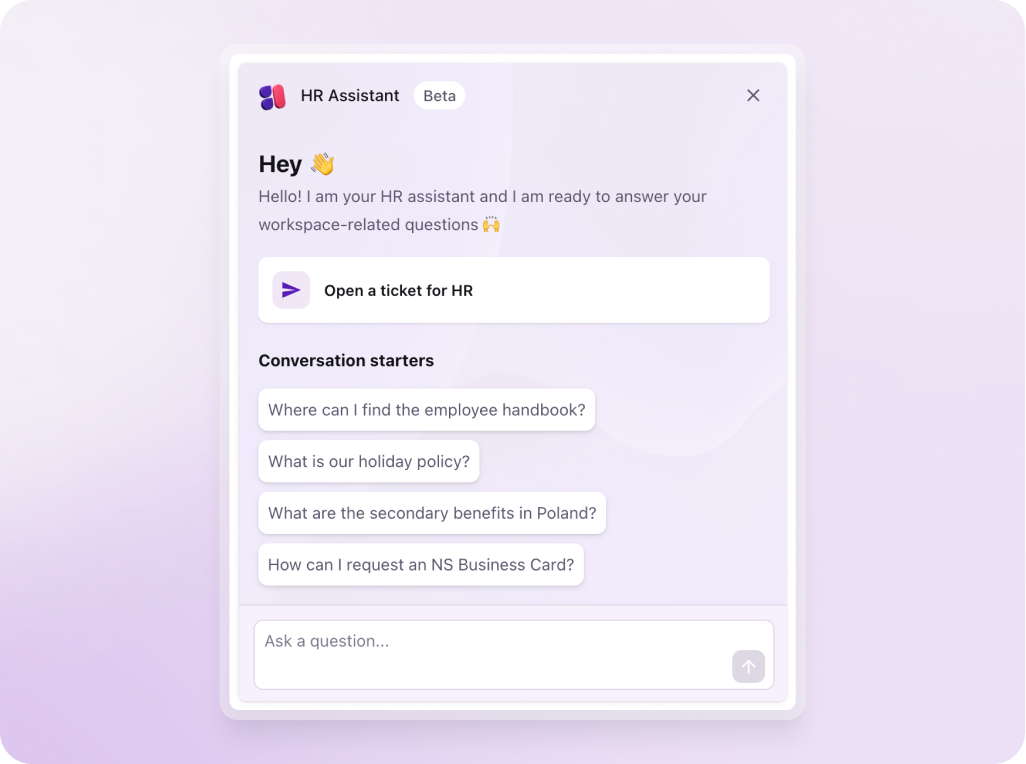
One place for every employee question. Tellent HR's ticketing system removes the friction from asking — no formal emails, no hesitation.
That shift matters more than it might seem — the directive doesn't just create a legal obligation, it changes the social dynamic around salary conversations in a way that will feel significant to employees, particularly those who are younger or working in cultures where pay has rarely been discussed openly.
What the directive requires from companies, beyond answering employee requests
Responding to employee requests is just one part of the obligation. The directive also places requirements on how companies handle pay information in the hiring process and on how they report it internally and to government authorities.
Salary disclosure in job postings and candidate communications
Companies must disclose salary information either in the job description or at the first point of contact with a candidate. For most HR teams, putting it directly in the job posting is the cleaner option — it removes ambiguity and makes the company's position visible to candidates before they apply.
The practical consequence of this requirement is reduced hiring flexibility. If a salary bracket is published and a candidate comes in expecting significantly more, there's less room to negotiate an exception.
The directive also prohibits asking candidates about their salary history. The intent is to stop past pay inequities from following candidates from one job to the next — if someone was underpaid previously, anchoring a new offer to that figure just perpetuates the gap. For HR teams and hiring managers who have relied on salary history as a shortcut for benchmarking, this requires a genuine change in practice.
Both requirements point to the same underlying need: compensation benchmarking that reflects current market reality, not historical patterns.
Government reporting requirements
In addition to employee and candidate-facing obligations, companies are required to report pay gap data to government authorities. This is where implementation timelines become more complicated, and where there's genuine variation across EU member states.
In France, for example, employees have been able to request pay information since June 6, 2026. In the Netherlands, the employee-facing obligations are the same, but the government reporting requirement has been pushed back — at least until early 2027. Reporting thresholds also vary: in some jurisdictions, the obligation kicks in at 100 employees; in others, the threshold differs. Companies with multiple entities in different countries need to understand whether they're assessed per entity or as a consolidated organization — the answer changes the scope of what's required.
The headline message: if you've been treating the employee-facing requirements as the whole picture, you're only looking at half of it.
The benchmarking process — and why it takes longer than you'd expect
The foundation of any pay transparency preparation is benchmarking: understanding where your salaries sit relative to market rates and relative to each other internally. Without this, you can't know where your gaps are, how defensible they are, or what it would cost to close them.
Most companies will need a dedicated benchmarking tool to do this properly. At Tellent, we use Ravio to assess salaries across three dimensions: market value, internal comparisons, and gender parity. The analysis is the straightforward part; the challenge is getting there.
For HR teams whose HRIS doesn't integrate directly with their benchmarking tool — which is still common — the data collection phase is largely manual. Every role, employee, and country must be processed by hand. Marieke is direct about the time this adds: "If there's not an integration between your HRIS and your benchmarking tool, you need quite a lot of time to manually collect all the data."
We started the process in January 2026, giving ourselves roughly six months before the June deadline. That was enough — but only because our entity sizes are relatively small and the number of employees affected in any single country is manageable. For larger or more complex organizations, the same preparation could take considerably longer. One external specialist that Marieke references estimated that some French companies will need at least 2 years to reach full readiness.
The other factor that extends timelines: this isn't a one-time project. Every new hire, every promotion cycle, every compensation adjustment needs to feed back into the benchmarking process. Pay transparency compliance is ongoing — and the systems need to be built to sustain it.
Closing pay gaps: the budget conversation no one wants to have
Benchmarking tells you where the gaps are. What happens next is where the real work and the real friction begin. But even from a clean starting position, we still had to ask ourselves: what standard do we actually want to hold ourselves to?
"Are we happy with 5 percent? Do we want 2 percent, zero percent?" Marieke asks. "That's a strategy decision you need to make as a company — what kind of stance are you taking and what do you want to offer your employees?"
It's worth being clear about what the 5 percent threshold actually means legally. The directive doesn't treat it as a safe harbor. Under EU Directive 2023/970, the burden of proof has shifted: it's the employer's duty to demonstrate that a pay gap is justified, not the employee's to prove discrimination. Any gap that can't be explained by objective criteria is a compliance risk, regardless of size. And if a gender pay gap exceeds 5 percent and the employer can't justify it within six months, the directive triggers a mandatory joint assessment with employee representatives. What starts as an internal HR audit becomes a structured, documented process, one that's considerably harder to manage if the groundwork hasn't been laid.
For companies with larger gaps, or those that haven't yet budgeted for remediation, the math can be significant. And it's a conversation that goes well beyond HR. Getting alignment on salary corrections requires making the case to finance and leadership. Getting everyone on board and on the same page will, in all honesty, probably take more time than the benchmarking itself.
The implication for timing: if your organization hasn't already had this budget conversation, start it now. Companies that discovered large gaps in 2025 and didn't build remediation costs into their 2026 budget are, in Marieke's words, facing "a massive impact."
Internal communication: don't wait for employees to come to you
One of the less-discussed aspects of pay transparency preparation is the communication strategy. Companies are not legally required to proactively notify employees of their rights under the directive. But waiting passively for requests to arrive is a risky approach — and for companies that operate in the HR space, a particularly uncomfortable one.
"I would strongly suggest all companies to have a workflow around this, so that employees know who to turn to get this information," Marieke says. For us, that means publishing the relevant information in our internal knowledge base, announcing it at all hands, and routing requests through our HR ticketing system to keep the process clear and low-friction.
The alternative — hoping no one asks — is, as Marieke puts it, a strategy some companies will attempt. "They will hide in the hopes that no one will come forward." The calculation is understandable: if you're sitting on gaps you can't yet explain, the quieter the rollout, the better. But Marieke has no patience for it. "Employees deserve to know." It's a short sentence that cuts through the legal complexity. Whatever a company's state of readiness, employees have the right to this information — and the directive now gives them a clear, low-friction path to get it.
A clear internal communication plan doesn't just satisfy a legal obligation. It signals that the company takes fair pay seriously — and it shapes how the first wave of requests lands. Employees who learn about the directive from their employer, through a clear process, will have a different experience than those who discover it independently and aren't sure who to contact or what to expect.
Summary
The EU Pay Transparency Directive is in effect. Here's what HR teams need to have in place:
- Benchmarking completed: Salary data assessed against market rates, internally across comparable roles, and for gender parity. Gaps identified and documented.
- Remediation plan in place: Gaps that can't be defended on legitimate grounds need to be addressed — with budget allocated and leadership aligned.
- Salary ranges published and salary history questions removed: Salary must appear in job descriptions or at first candidate contact. Asking candidates about their previous salary is prohibited.
- Employee request workflow established: A defined process for handling salary information requests, with HR as the primary point of contact.
- Ongoing maintenance built in: New hires, promotions, and compensation changes need to feed continuously back into the benchmarking system. This is not a one-time project.
- Government reporting timelines understood: Reporting requirements and deadlines vary by country and entity structure. Know what applies to your organization.
The directive is disruptive precisely because it makes visible what many companies have preferred to keep opaque. For organizations that have been paying fairly and can show their work, the transition is manageable. For those who haven't, the clock has already started.
Conclusion
Pay transparency is no longer a future concern — it's the current reality for HR teams across Europe. The companies that will navigate it best are the ones that treat it as an ongoing practice, not a compliance checkbox to complete and file away.
Getting there requires honest benchmarking, difficult budget conversations, and a commitment to fair pay that goes beyond the legal minimum. None of that is easy, but the framework exists, and the direction is clear.
To help you work through the action items, we've put together a practical compliance checklist covering all four areas — mapping and benchmarking, formalizing pay criteria, securing high-risk HR processes, and structuring documentation and governance. Use it with your HR, legal, and finance teams to track progress and assign ownership.